Higher peak current ratings or larger stated battery capacities can make a jump starter look more powerful on a product page. But if those ratings overstate its actual performance, buyers may find that it cannot deliver enough current to start their vehicles—and your brand may face customer complaints.
Jolly Flying Starter is committed to accurately stated specifications, supported by test records. The J50 current records below provide a concrete example: buyers can check a specification against measured readings.
Before comparing headline numbers, verify three things: how long the current is maintained, the battery’s nominal energy, and the conditions behind starting claims.
A product page can display a large amp figure. OEM buyers need to know what was actually measured, how long it was recorded, and under what conditions.
**Two J50 short discharge records allow buyers to compare the 1,440 A test setting directly with measured current:
J50 test record | Test setting | Measured current range | End voltage |
| J50 test record | Test setting | Measured current range | End voltage |
|---|---|---|---|
| Sample 1, run 1: 1.5 s | 1,440 A | 1,440–1,442 A | 10.04 V |
| Sample 1, run 2: 2.0 s | 1,440 A | 1,438–1,440 A | 9.89 V |
The tests were recorded on 2 August 2026 at an ambient temperature of 20.1°C. These records provide measured evidence of current near 1,440 A in the stated short discharge tests. Buyers can compare the test setting with the actual readings, rather than rely on the advertised number alone.
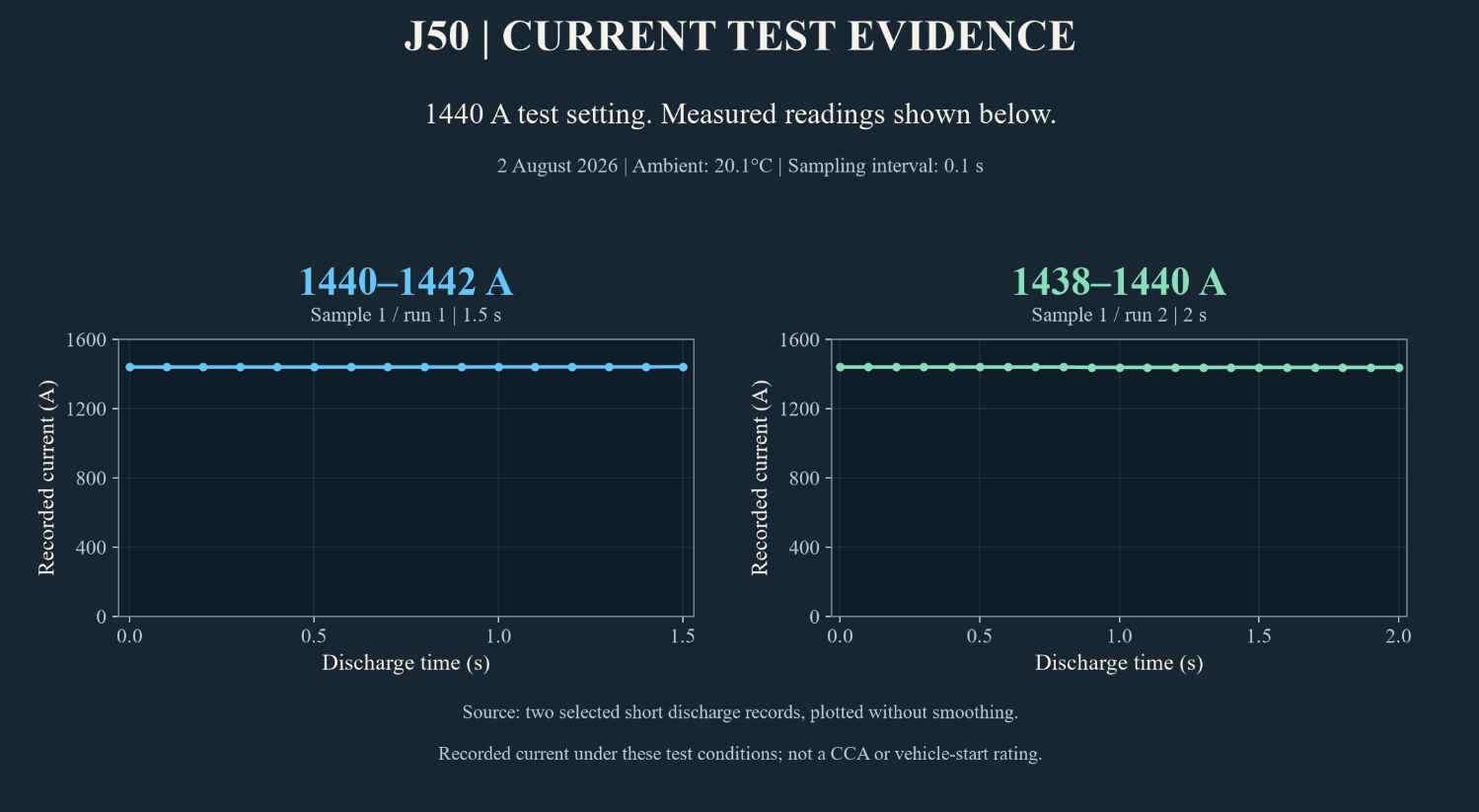
Two selected short discharge records, sampled every 0.1 s. This example supports the recorded current under these conditions; it does not establish CCA or vehicle starting capability.
Buyer check: request comparable evidence behind any supplier’s rating. A genuine peak reading and a sustained current rating use different definitions, so align the test methods before comparing them. The core issue with an inflated specification is that the claim exceeds what the applicable test supports.
Wh = (mAh ÷ 1,000) × nominal voltage. Source: Battery University glossary.
| Illustrative label | Nominal energy |
|---|---|
| 20,000 mAh at 3.7 V | 74 Wh |
| 10,000 mAh at 7.4 V | 74 Wh |

Nominal energy calculations using hypothetical values.*
The first mAh figure is twice as large, but the nominal energy is identical. A larger mAh figure alone proves neither more energy nor an inflated rating.
Buyer check: confirm the voltage reference, battery pack configuration, and nominal Wh. If the claim concerns measured output energy, also request the discharge load, temperature, cutoff conditions, and measurement point. Energy measured at an output port and nominal battery energy are different quantities.
The capacity examples above illustrate measurement principles; they are not Jolly Flying Starter or competitor test results.
“Starts large diesel engines” is not a sufficient basis for product selection without the vehicle model, system voltage, temperature, vehicle battery condition, and jump starter’s initial charge level.
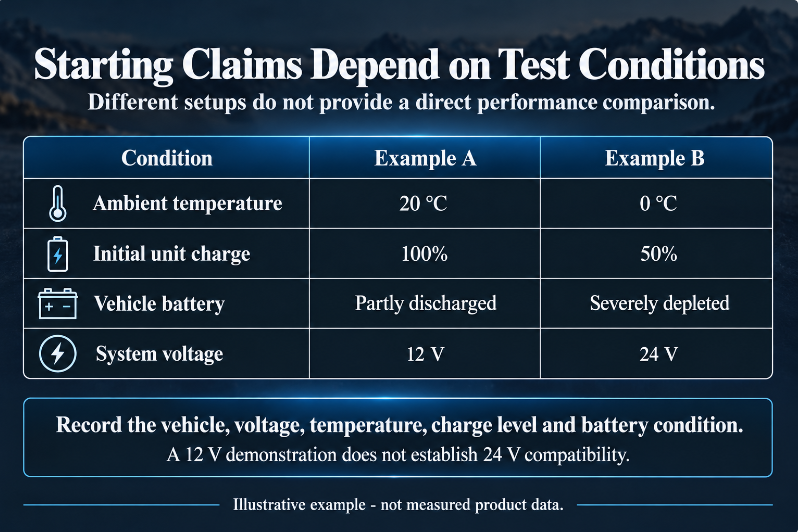
Hypothetical test setups, not actual starting results.
A real test example: in its 2016 test of seven lithium jump starters, ADAC reported that none met their stated performance at −18°C and only one did at 0°C. This historical result applies to those tested products; it does not represent today’s market or directly prove deliberate mislabeling. It shows why the conditions behind a rating need to be checked. Source: ADAC test.
Buyer check: for winter use, request evidence at the intended temperature. A 12 V starting demonstration does not establish 24 V compatibility. For “starts per charge,” also check attempt duration, intervals, and whether the vehicle battery recovered or was recharged between attempts.
Overstated starting capability can lead to the wrong product selection, failed assistance, returns, and replacement shipping costs. Overstated starts per charge can cause additional charging interruptions in a workshop.
Illustrative cost calculation: saving €2 on each of 1,000 units saves €2,000. If 50 additional returns cost €40 each to process, the saving disappears—before accounting for support time, lost customer trust, or damage to your brand’s reputation.
Customers buy the promise on your packaging. Verify the evidence before copying a supplier’s specifications into your product listing.
| Step | Required decision or record |
|---|---|
| Define the application | Vehicles, voltage, temperature, and frequency of use |
| Agree on methods | Rating definitions, measurement points, and acceptance criteria |
| Review the evidence | Records match the quoted model and configuration |
| Verify the sample | Test and document results under the agreed conditions |
| Control production | Retain an approved sample; agree on batch checks and change review |
Decision rule:** align different test methods before comparing results; mark missing evidence as “unverified”; if repeated tests under the agreed method do not support a claim, request an explanation, correction, and retesting. Have qualified personnel perform high current tests.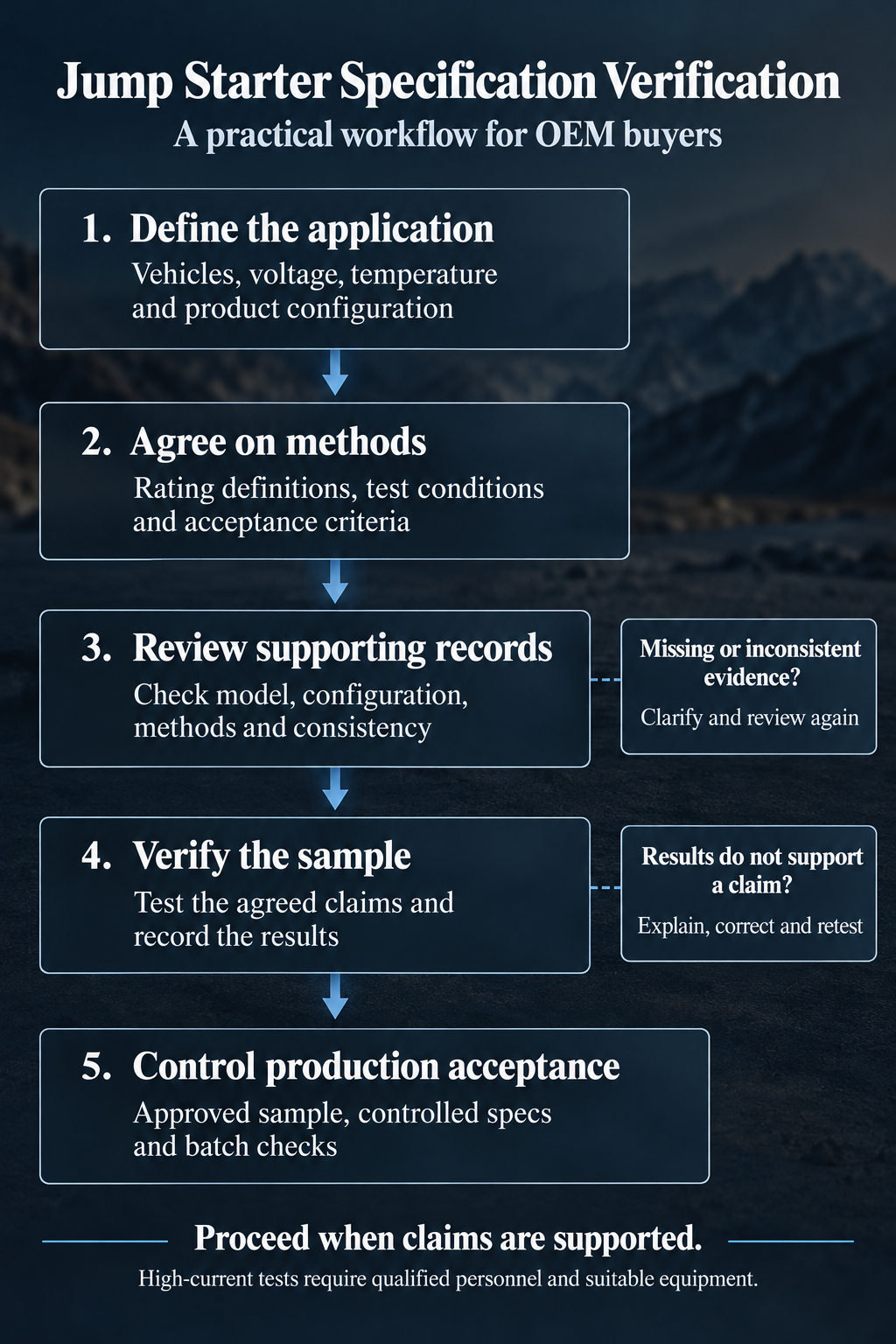
Five steps from application requirements to production acceptance.*
The J50 current example illustrates the approach: match each claim to a specific test record and its conditions. Use the checklist below to review J50 specifications, and use the J40-R’s own records when evaluating that model.
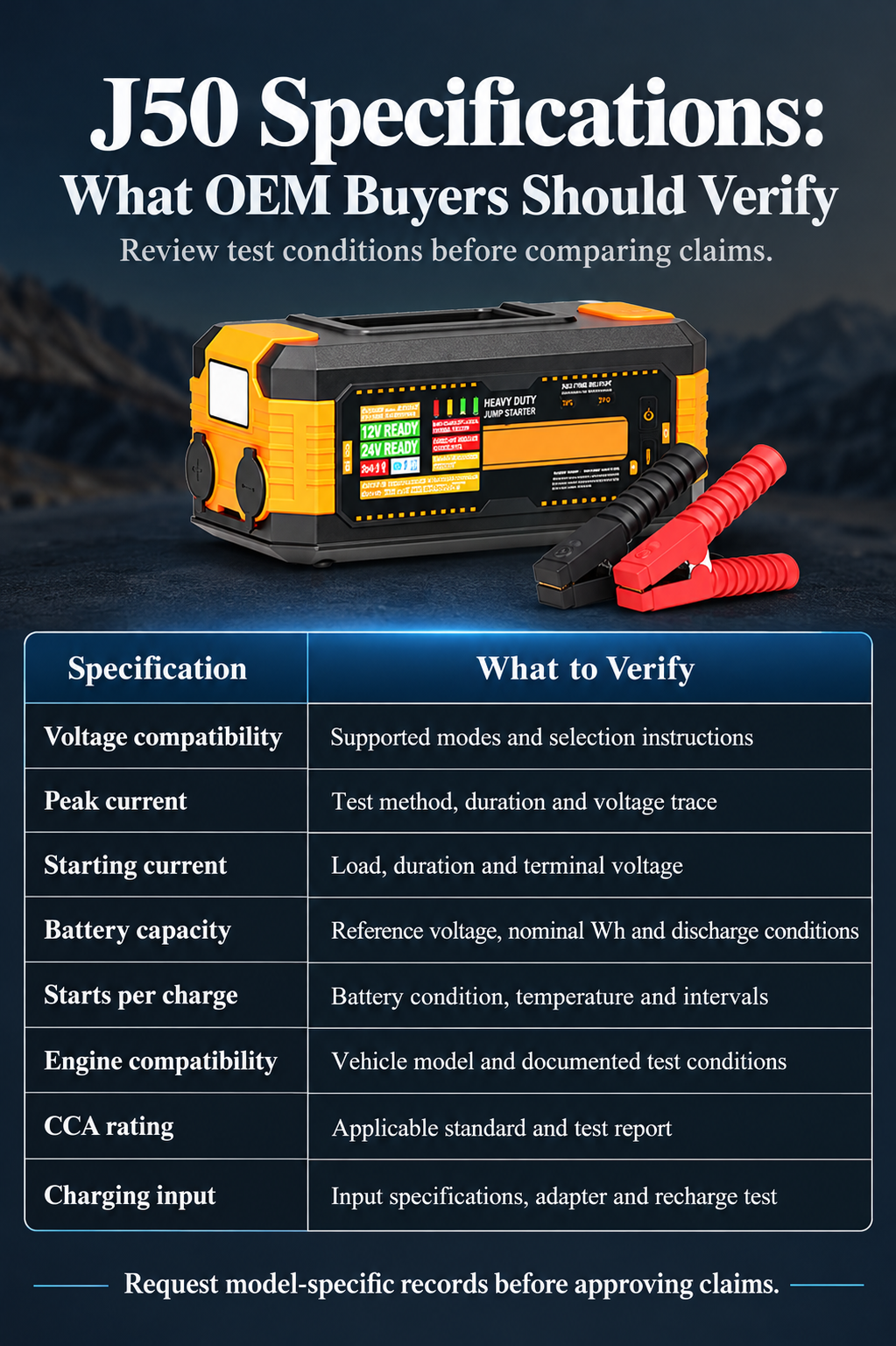
J50 verification checklist. Performance evidence comes from records for the relevant model.*
For your OEM or private-label project, use supported specifications on your packaging and product listings. Verifiable evidence helps your brand make promises it can deliver on.
Contact Jolly Flying Starter with your vehicle types, required voltage, operating temperatures, and frequency of use. Ask which model specifications and supporting records are available for evaluation.
