5,000A, 10,000A, 30,000A. The numbers on jump starter product pages keep getting bigger. It is easy to assume that buying more amps means being better prepared for an emergency.
But if a page makes a huge current rating its headline without explaining what kind of current it is, how long it lasts or how it was measured, why should you pay more for that number?
False or exaggerated ratings can lead you to overestimate a product when you buy it, then discover its limitations when you need it. If your car will not start, you are the one left dealing with the wait, roadside assistance and a disrupted journey.
Before buying, look for the evidence behind the number. A J50 discharge record at approximately 1,440A provides a practical example of how to read current, time and voltage together.
Open your vehicle manual and compare these three points with the product information.
| What you need to know | What to look for |
|---|---|
| The voltage required for jump-starting your vehicle | Whether the jump starter supports the corresponding 12V or 24V system. |
| Petrol or diesel engine, and engine capacity | Whether the product lists separate suitability ranges for both engine types and covers your configuration. |
| Where you expect to use it | For winter parking outdoors, check the stated cold-weather conditions and relevant starting performance. |
For example, if you drive an 8.0L petrol vehicle and want an emergency kit to keep on board, start with models explicitly listed as suitable for that type of vehicle. If you drive a large diesel pickup and often park in cold conditions, check the relevant diesel compatibility and temperature conditions more closely.
Starting performance also depends on battery condition, the connecting cables and engine oil viscosity. Identifying your vehicle and environment gives you a better basis for choosing than guessing an amp figure from engine capacity alone. Delco Remy: Cold Weather Cranking
First, find the name beside the number.
Peak amps describe a short-duration peak. Check the voltage, duration and temperature associated with the rating.
Starting current or cranking current generally describes starting output, but manufacturers may use different rating conditions. Read the duration and test conditions alongside the figure before comparing products.
If a specification lists both peak current and discharge current for a stated duration, treat them as separate measurements. Look for information that gives you current, time and voltage together. The J50 record below shows what this kind of information lets you examine.
Battery capacity in mAh or Wh describes stored charge or energy. It helps you understand capacity, while starting capability also requires a look at output performance and vehicle suitability.
An exaggerated rating takes advantage of a reasonable wish: you want something powerful enough to work when you need it. A larger amp number attracts attention and can help make a sale. But if the actual output does not meet the advertised conditions, your money has not bought the promised capability.
This kind of marketing can shift your comparison away from “Will it suit my vehicle?” towards “How many more thousand amps does this one advertise?”
Pay particular attention to these three patterns:
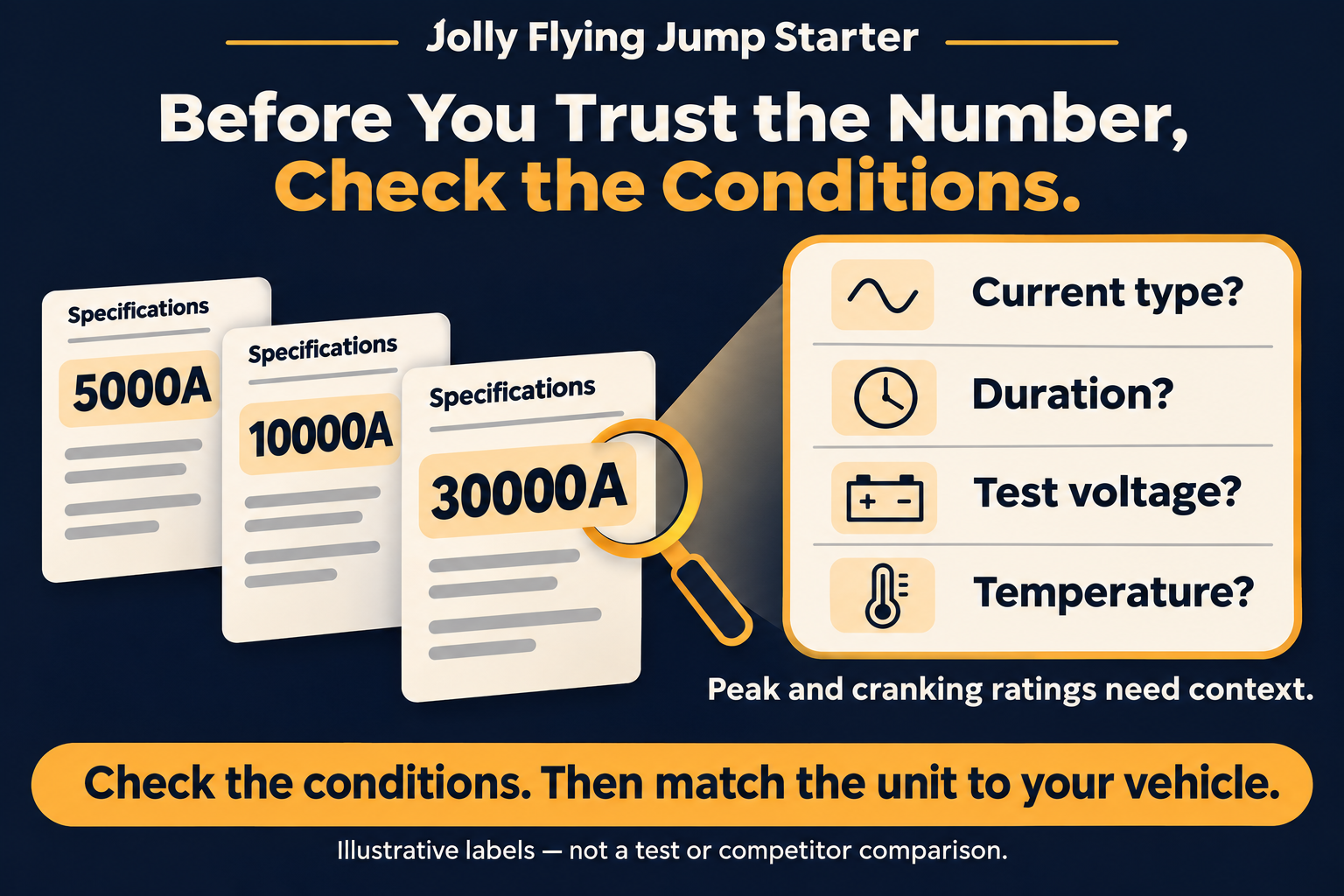
llustrative guide: check current type, duration, test voltage and ambient temperature, then consider your vehicle. The numbers are example labels, not test results for specific competing products.*
If the main selling point is an ever-larger amp number, check what supports it. Clearly stated conditions and traceable records help you understand what a rating represents. Establishing that a specific product has a false rating also requires checking its actual output against the same conditions it claims.
Temperature deserves particular attention. In a 2016 test of seven jump starters, ADAC recorded products falling short of their stated performance in cold conditions. This historical test is a reminder to check the environment in which a performance result was obtained. ADAC jump starter test
The J50 from Jolly Flying Jump Starter has internal bench discharge records that retain current, voltage and elapsed time. In one 2-second record from 2 August 2026, the ambient temperature was 20.1°C and the recorded current ranged from 1,438 to 1,440A. Four sampling points are shown below.
| Elapsed discharge time | Current | Recorded voltage |
|---|---|---|
| 0.5 seconds | 1,440A | 11.14V |
| 1.0 seconds | 1,438A | 10.70V |
| 1.5 seconds | 1,438A | 10.31V |
| 2.0 seconds | 1,438A | 9.89V |
Source: internal J50 bench discharge record. The table shows four selected sampling points; the complete record was sampled at 0.1-second intervals.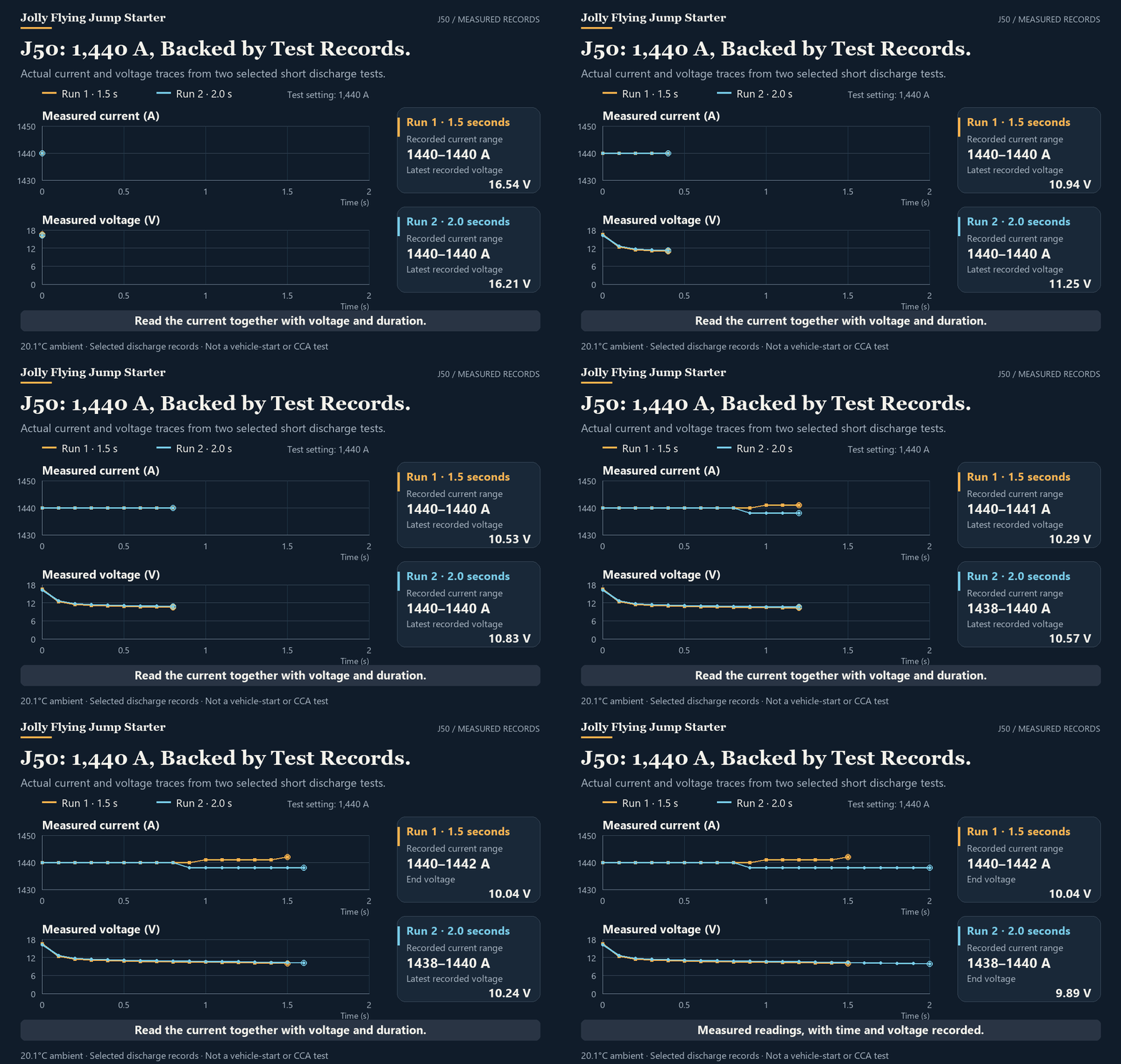
The animation uses two selected internal J50 bench discharge records: orange for the 1.5-second record and blue for the 2-second record. The table above corresponds to the blue trace. Ambient temperature was 20.1°C. The horizontal axis shows actual recorded time; animation pacing is for presentation.
This is what makes “approximately 1,440A” traceable. It refers to this specific 2-second bench discharge record, with original sampling points and a voltage reading at each point. You can follow the record to see how the figure was obtained and understand J50’s performance during that short discharge.
Peak current and the short-duration discharge current shown here should be read separately, using their respective definitions and test conditions. Considering current, duration, corresponding voltage and vehicle suitability together gives you a stronger basis for choosing.
J50 provides actual records you can refer to when comparing specifications. Use them alongside your vehicle’s voltage system, engine configuration and expected conditions to assess whether it meets your needs.
Instead of repeatedly comparing big numbers, describe your situation in one question:
My vehicle is a [model year] diesel with a [stated engine capacity] engine and a 12V system. Winter parking temperatures can fall below freezing. Is this model suitable, and can you show the relevant compatibility and cold-weather information?
Look for a reply that addresses your vehicle and environment. Clear product information should help you identify compatibility, what the ratings mean and the applicable conditions.
If a page includes a vehicle-start video, check whether it identifies the vehicle, engine configuration and environment. A single starting demonstration can be a useful reference, while confirming suitability for your conditions requires corresponding information.
Once you have found a few suitable products, compare features you will use in practice:
Make your goal specific. For example: “I want an emergency kit for my 12V petrol vehicle that fits in the boot and is easy to check and recharge.” That gives you a more useful basis for deciding which product is worth buying.
If you are choosing a jump starter for a pickup or commercial vehicle, start with J50’s actual records and product compatibility information. Share your vehicle details and expected conditions to confirm suitability. Explore Jolly Flying Jump Starter J50
